


Factory-Finished or Site-Finished Wooden Doors: Which One to Choose?
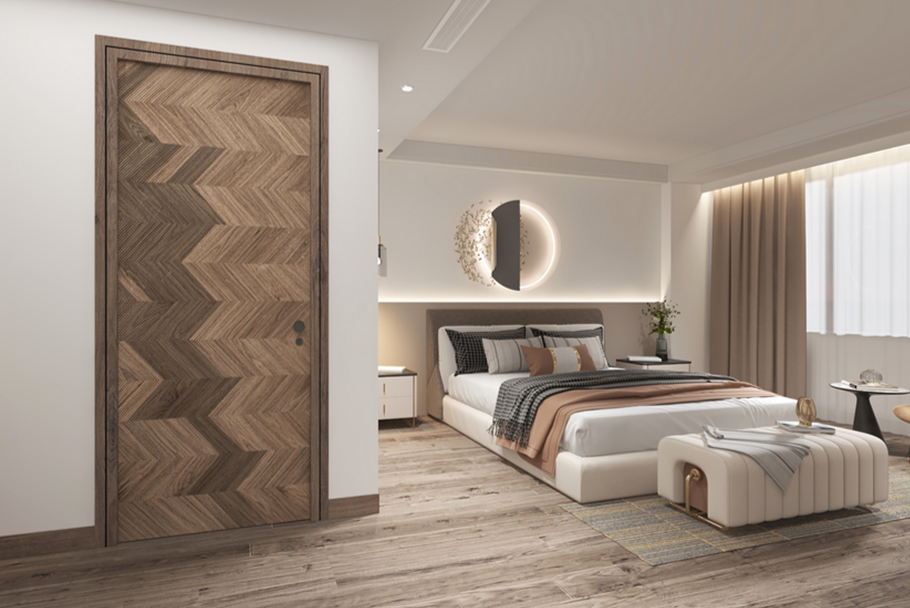
For centuries, carpenters used to fabricate the door leaf, install it within a wooden door frame, and apply polish or paint at the project location. Although this method was a standard practice for years, it also relied heavily on site conditions and workmanship. The demands of modern construction, however, are somewhat different. While developers expect predictable timelines and uniformity in finish across units, clients seek durability without ongoing maintenance concerns. These expectations have driven the shift towards factory-finished engineered wooden doors that offer many clear advantages over site-finished alternatives. In this article, we’ll explain these differences to help you make an informed decision.
Site-Finished Wooden Doors: The Limitations
Site-finished wooden doors are typically constructed from solid timber and completed at the project site. After installation within a wooden door frame, the surface is sanded, stained, polished, or painted manually.
While solid wood has natural appeal, the finishing process introduces several variables.
- Environmental Dependency: On-site finishing is affected by humidity, temperature, and dust levels. These factors can influence drying times and surface consistency. Even slight variations in application technique may result in uneven grain pattern or texture inconsistencies.
- Extended Timelines: Sanding, staining, and curing require time. In large developments, repeated finishing processes across units can significantly extend project schedules.
- Dimensional Stability: Solid timber naturally expands and contracts with moisture changes. Over time, this movement may result in the formation of cracks or minor misalignment within the frame.
- Inconsistent Replication: Achieving identical shades and grain patterns across multiple doors is challenging, particularly in large residential or hospitality projects.
While site-finished wooden doors remain viable in certain custom settings, large-scale projects increasingly require higher levels of precision and predictability.
What are Factory-Finished Engineered Wooden Doors?
Factory-finished engineered wooden doors are doors manufactured using advanced core construction and completed under controlled factory conditions before reaching the project site. Unlike solid timber doors that are fabricated and polished on location, these doors are engineered as precision products designed for structural stability, finish consistency, and ready installation.
At the core, engineered wooden doors use multi-layered construction rather than a single solid timber slab. Cross-laminated or composite core materials are arranged in opposing directions to reduce internal stress and limit expansion or contraction caused by humidity and temperature changes. This layered structure enhances dimensional stability and long-term performance.
The “factory-finished” element refers to surface treatments applied in dust-controlled and climate-regulated facilities. Finishes such as , or painted surfaces are completed before dispatch, ensuring uniform colour, texture, and durability. Many systems are also supplied as integrated doors and frames, where the door leaf and wooden door frame are engineered together with hardware preparation included, allowing for precise alignment and streamlined installation.
Read Also: Top Finish Options for Engineered Wood Doors
Core Comparison: Where the Real Differences Lie
1. Precision Manufacturing vs On-Site Variability
Factory-finished wooden doors benefit from controlled production processes. Cutting, pressing, finishing, and inspection follow defined standards, resulting in uniform dimensions and surface quality.
This precision improves alignment between doors and frames. Gaps remain consistent. Edges are clean. Installation becomes more predictable.
By contrast, site-finished doors depend heavily on manual processes. Measurement errors, uneven sanding, or inconsistent polish application can introduce minor irregularities that affect overall appearance.
For multi-unit residential developments or commercial buildings, manufacturing precision ensures visual uniformity across all installed units.
2. Dimensional Stability and Long-Term Performance
Solid timber reacts to moisture. Seasonal humidity changes can cause doors to swell or shrink, potentially leading to friction against the frame or minor distortions over time.
Engineered wooden doors mitigate this risk. The layered core construction distributes stress evenly, reducing expansion and contraction.
When paired with a compatible wooden door frame, engineered systems offer improved dimensional stability. Over years of use, this stability reduces maintenance requirements and preserves operational smoothness.
In climates with fluctuating humidity levels, structural reliability becomes particularly important.
3. Integrated Doors and Frames Systems
Modern construction increasingly favours integrated door and frame systems.
When factory-finished doors are supplied alongside coordinated frames, hinge positioning, alignment tolerances, and finish continuity are pre-engineered. This approach reduces the need for site-level adjustments.
Improved alignment enhances acoustic sealing and structural integrity. The door leaf and wooden door frame function as a cohesive unit rather than separate elements assembled under variable conditions.
Site-finished doors, in contrast, may require trimming, re-polishing, or adjustment during installation. Such modifications can affect finish consistency and increase labour time.
Integrated systems offer clarity in responsibility, performance testing, and lifecycle resilience.
4. Surface Finish and Durability
Surface performance significantly influences long-term satisfaction.
Factory-controlled coatings deliver higher consistency in sheen and texture. PU finishes and veneer laminates offer improved resistance to scratches and stains compared to many site-applied alternatives.
In high-traffic environments such as offices or hospitality projects, durability matters. Reduced susceptibility to surface damage helps maintain visual quality.
Modern wooden doors with minimalist finishes particularly benefit from factory finishing, as even minor irregularities become visible on clean surfaces. Lower maintenance requirements over time further enhance their practical value.
5. Installation Speed and Project Efficiency
Construction schedules today demand efficiency. Pre-finished wooden doors arrive ready for installation. There is no requirement for sanding, staining, or curing on site. Installers position the door within its frame and complete hardware fitting.
This reduces labour hours and minimises dust and site disruption. In large-scale projects, cumulative time savings are substantial.
Improved coordination between teams handling doors and frames also streamlines workflow. Reduced rework lowers project complexity and supports faster handover.
6. Design Flexibility and Catalogue Variety
Architectural design increasingly values flexibility. A comprehensive engineered wood door design catalogue, like the one from Mikasa Doors & Frames, typically includes a broad selection of veneer laminates, painted finishes, textured surfaces, and contemporary grain patterns. Flush doors, panelled configurations, and architectural modern wooden doors are available in standardised formats.
Because finishes are applied under controlled conditions, consistency across multiple units is maintained. Developers can specify the same design throughout an entire project without compromising finish replication.
Site-finished solid timber doors may offer customisation, but precise replication across large quantities remains challenging.
7. Hardware and Ironmongery Integration
Door performance depends not only on the door leaf but also on the precision of hinges, locks, handles, and closing systems. In site-finished wooden doors, hardware installation often relies on on-site measurements and manual adjustments, which can lead to minor alignment inconsistencies. Over time, these variations may affect smooth operation and increase wear within the wooden door frame.
Factory-finished engineered systems address this through pre-engineered preparation. When doors and frames are developed as coordinated sets, hinge positioning and lock cut-outs are integrated during manufacturing. This ensures accurate alignment, smoother operation, and long-term durability. For residential and commercial projects alike, integrated hardware preparation enhances reliability while reducing on-site adjustments and installation complexity.
8. Cost Predictability and Lifecycle Value
While solid timber doors may appear straightforward initially, hidden costs can accumulate.
Factory-controlled manufacturing reduces material wastage. Installation efficiency lowers labour expenditure. Dimensional stability reduces maintenance interventions.
Over time, engineered factory-finished wooden doors often demonstrate better lifecycle value. Budget predictability is particularly important in large developments where minor variances can significantly affect overall cost.
When evaluated beyond the initial purchase price, the total cost of ownership becomes a key differentiator.
9. Sustainability and Responsible Manufacturing
Sustainability considerations increasingly influence material selection. Engineered wooden doors optimise the use of timber by reducing reliance on large solid hardwood sections. Layered construction makes efficient use of resources while maintaining structural integrity.
Controlled production minimises waste and improves material yield. Many systems align with green building frameworks and responsible sourcing standards.
Compared with conventional solid wood systems, engineered alternatives can offer improved resource efficiency without compromising aesthetics.
Read Also: Top Finish Options for Engineered Wood Doors
Applications Suited to Factory-Finished Doors and Frames Systems
Factory-finished engineered doors and frames systems are highly versatile and well-suited to a wide range of applications across residential, hospitality, and commercial environments. Their precision manufacturing, integrated performance, and finish consistency make them adaptable to projects of varying scale and complexity:
- Residential apartment developments requiring uniformity
- Hospitality projects demanding durability
- Office and commercial spaces with frequent usage
- Large-scale housing where cost predictability is essential
- Renovation projects seeking minimal disruption
- Developers prioritising integrated doors and frames solutions
In each of these contexts, consistent performance and streamlined installation offer tangible benefits.
A Smarter Direction for Modern Wooden Doors
The difference between factory-finished and site-finished wooden doors is not merely cosmetic. It lies in manufacturing precision, structural stability, installation efficiency, and long-term performance.
Engineered, factory-finished systems address many of the limitations associated with solid timber doors finished on site. By integrating doors and frames into coordinated sets, they deliver predictable alignment, finish continuity, and lifecycle resilience.
As construction standards evolve, material decisions must reflect modern expectations. Whether specifying minimalist modern wooden doors or exploring options within a detailed wood door design catalogue, decision-makers increasingly prioritise solutions that combine aesthetic flexibility with technical reliability. The future of wooden doors lies in engineering that respects tradition while enhancing performance.
About Mikasa Doors
Mikasa Doors & Frames specialises in factory-finished, ready-to-install door sets designed to suit diverse interior environments. These systems are available in multiple configurations, including individual door leaves, frames, or complete integrated sets. Rather than supplying isolated components, Mikasa develops coordinated door and frame solutions where the leaf, wooden door frame, and architectural ironmongery function as a unified system.
Each door set is carefully engineered and tested to deliver certified levels of performance. The focus extends beyond appearance to include structural resilience, durability, and lifecycle reliability. For projects seeking refined design combined with dependable technical performance, Mikasa Doors & Frames offers engineered solutions that simplify installation while maintaining consistent quality. For product enquiries, call us at 1800 833 0004, email us at info@mikasadoors.com, or visit our contact form, and we will get back to you as soon as possible.
Frequently Asked Questions

3 Reasons to Choose Mikasa for Hospital Doors
Mikasa doors are versatile in design and you can find options that offer features like fire-retardan

How Hardwood Doors are Different from Engineered Wood Doors
Harwood is, without doubt, one of the oldest materials used for making doors and continues to be one

3 Charming Wood Species that You Can Choose For Your Bedroom Door
A door is one of the most important considerations when designing a bedroom. While the door design n
 Email:
  Toll Free No.: